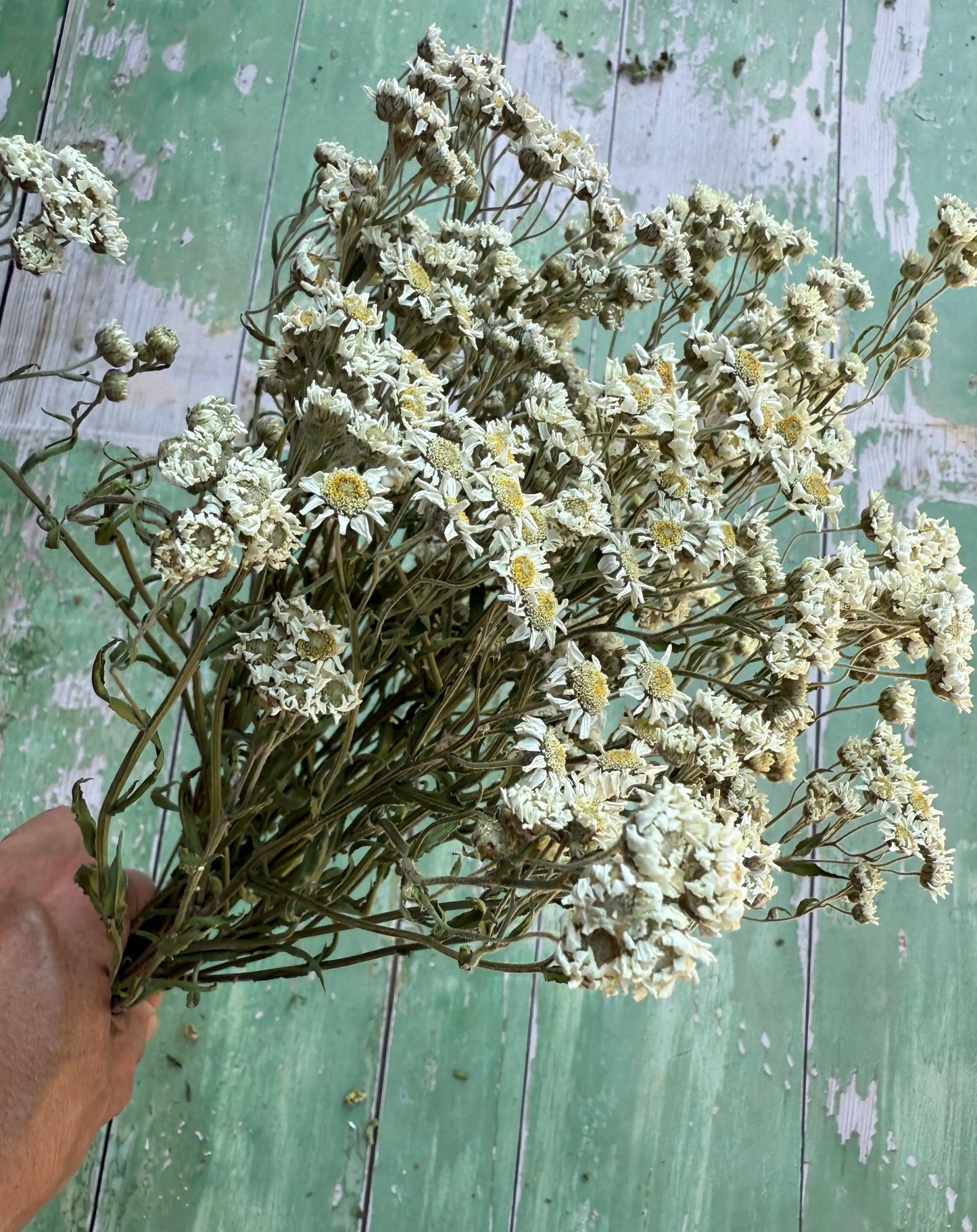


Achillea 'Ballerina' Dried | White Double Yarrow
Achillea 'Ballerina' Dried | White Double Yarrow
Couldn't load pickup availability
If you love the airy, romantic look of Gypsophila (baby's breath) but dislike how brittle and messy it becomes when dried, Achillea 'Ballerina' is the answer. Where dried gypsophila shatters into confetti the moment you look at it, Ballerina holds together. Where gypsophila fades to dusty grey-cream within months, Ballerina stays a warm antique ivory for years. Where gypsophila's tiny single flowers scatter across your kitchen table every time you brush past an arrangement, Ballerina's fully double blooms cling to their stems and stay put. The frothy, cloud-like filler that finally solves the "I want gypsophila without the mess" problem.
Barn-dried on the farm at Salle Moor Hall — Achillea 'Ballerina' generous bunches of branched stems, harvested at the peak of their summer flowering and hung upside-down in the drying barn until the ruffled double flowers are set and the ivory colour is locked in. Each stem branches into dozens of small clusters, giving you an enormous amount of coverage per bunch — a properly generous handful that goes further in arrangements than the stem count suggests.
Achillea ptarmica 'Ballerina' is a fully-double-flowered cultivar of common yarrow, bred specifically for the ruffled, densely-petalled flower form that gives it its name. Where standard yarrow produces flat-topped umbels of tiny single florets, Ballerina produces sprays of tiny puffball flowers — each one a compact rosette of white ray florets around a small yellow eye, dozens per stem cluster. The visual effect is halfway between chamomile and gypsophila, with the durability of neither. Someone described it as looking like tiny marshmallows or popcorn scattered across the stems, which is exactly right.
Barn-dried at Salle Moor Hall, Norfolk. Grown chemical-free on our own cutting field, hand-harvested at peak bloom when the flowers are open but not yet ageing, hung upside-down in the barn to dry naturally. No air miles, no imported stems, no plastic wrapping, no dyes or preservatives — just good English cottage garden yarrow, grown and cared for entirely by us. Seasonal, available while our summer stock lasts.
Perfect for the "I need soft filler" job in arrangements. This is the filler flower that solves the volume problem in dried arrangements — where big-headed statement flowers (helichrysum, achillea Cloth of Gold, hydrangea) need something soft between them to breathe, Ballerina steps in as the airy connector. Autumn and winter wreaths particularly benefit from the frothy texture, and wedding work has adopted Ballerina as the durable understudy to gypsophila for buttonholes, bridal bouquet edges, and hair pieces where shedding petals would be catastrophic.
Pairs beautifully with dried lavender for the classic cream-and-purple cottage garden combination — the frothy white against the structured purple spikes is one of the most photographed pairings in dried arrangement work. Also excellent with dried larkspur, statice, dried oxeye daisy, and dried Feverfew for all-white/cream/soft schemes, and with warm autumn tones (dried carthamus, calendula, warm russet dried grasses) for wreath work. Particularly good in bridal arrangements where the ivory-cream reads warmer and softer than pure white, complementing skin tones in bridal photography.
A note on the RHS Plants for Pollinators credential. Achillea millefolium is an RHS-listed pollinator plant in its growing form — the same flat-topped landing platform that attracts butterflies, hoverflies and bees in the garden also gives the dried version its light, airy character in arrangements. We grow Ballerina alongside other pollinator-friendly varieties on our cutting field, and the plants earn their keep as living flowers before we cut them for drying.
Care note: the stems dry firm and the flower clusters are more robust than most soft-textured dried flowers, but the individual petals can be slightly delicate on very old or overhandled bunches. Handle by the base of the bunch, avoid squeezing the flower heads directly, and keep out of direct sunlight to preserve the ivory colour for years. Unlike gypsophila, you can move Ballerina between arrangements multiple times without losing significant material — one of its most useful practical advantages.