Echinacea Cones Dried | Coneflower Seed Heads Norfolk
Couldn't load pickup availability
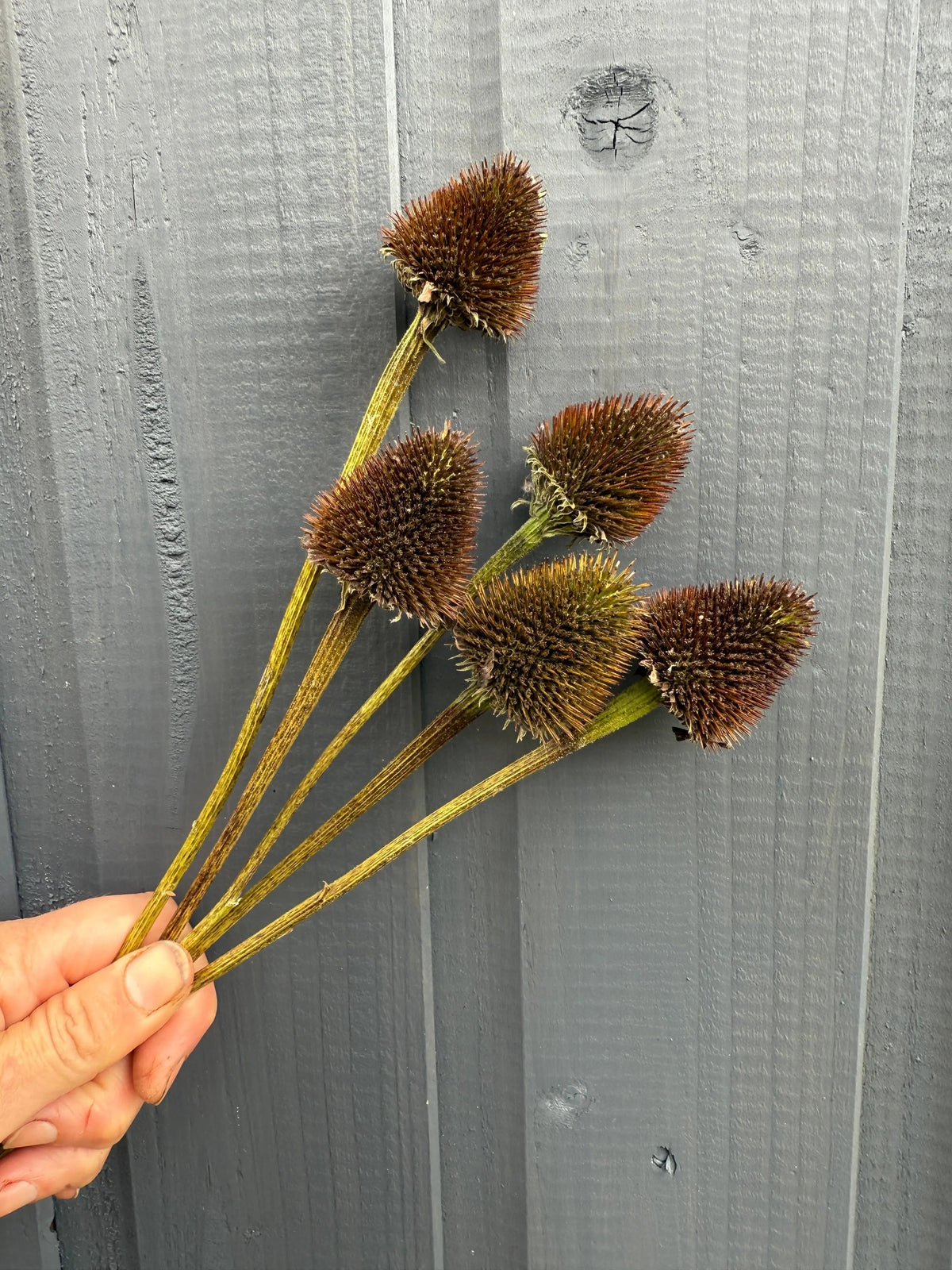
While Echinacea is loved for its purple summer petals, the real drama happens when the petals drop. What remains is a magnificent cone-shaped seed head that looks like a miniature beehive, or a spiky hedgehog stuck on the end of a stem — the botanical name Echinacea comes from the Greek ekhinos, meaning hedgehog, and the resemblance is exact. Dried to a rich warm palette of burnt orange, chocolate brown, and deep bronze, these cones are one of the toughest, most architectural dried elements you can buy. The bold structural "full stop" that gives autumn arrangements their focal point, and one of the very few dried flowers that reads as sculpture even outside a vase.
Barn-dried at Salle Moor Hall, Norfolk. Bunches of approximately 5 stems, each 40-50cm long, with the spiky cone-shaped seed heads sitting boldly at the tip of each stem. Hand-harvested in late summer after the petals have faded but before the birds strip the seeds — timing matters, because leaving them too long means the birds get there first. Grown chemical-free on our own cutting field. No air miles, no imported stems, no dyes or preservatives — just genuinely honest English cottage garden Echinacea, cultivated and cared for entirely by us. Currently in stock
What makes Echinacea cones distinctive
- The cone is a seed head, not a flower — this is the mature centre of the flower after the petals have dropped. Dozens of tiny seeds are packed into the spiky central structure, which acts as both seed protection and (in the garden) bird food through autumn and winter
- Hard, woody, prickly to the touch — genuinely sharp. The Greek etymology (hedgehog) is accurate rather than poetic. Handle by the stems, not the cones
- Warm autumn colour palette — the cones dry to a natural mix of burnt orange, chocolate brown, and deep bronze, sometimes with green-tinted stems. Reads as the "autumn full stop" colour you actually want to use rather than the muted brown-tan of most autumn stems
- Exceptional durability — among the very toughest dried elements available. Won't shed, won't crumble, won't get squashed. The kind of dried flower that survives multiple house moves, various display arrangements, and years of casual handling
- Structural focal points — unlike soft dried elements that add texture or filler, Echinacea cones read as visual anchors. Two or three in an arrangement give the whole composition a resting point for the eye
- Winter garden heritage — in the growing form, gardeners deliberately leave Echinacea seed heads standing through autumn and winter for both bird food (goldfinches love them) and structural garden interest. Bringing that same winter-garden architecture indoors is genuinely lovely
Styling ideas
- Autumn wreaths — the flat cone base makes Echinacea easy to nestle into moss or foliage wreaths. Their bold silhouette gives autumn wreaths the strong focal detail that softer dried elements can't provide. Particularly good with dried grasses, Nigella seed heads, and warm-toned dried flowers
- Christmas mantel and garland decoration — the dark bronze cones look spectacular alongside pinecones, dried orange slices, cinnamon sticks, and evergreen foliage. Traditional Christmas palette elevated by the distinctive cone shape
- The contrast vase — place stems in a vase with soft fluffy Bunny Tails. The visual contrast between the sharp dark cones and the soft cream grass is one of the most balanced pairings in dried floristry
- Modern minimalist single-species — three or five stems in a matte ceramic vessel or plain glass bottle creates a distinctly modern arrangement. The bold structural silhouette suits gallery-white interiors surprisingly well
- Table decor and tablescapes — snip the heads off and use them to fill a shallow glass bowl, scatter along a table runner, or arrange around candles for autumn dinner parties. Cones without stems become sculptural objects in their own right
- Mixed autumn bouquets — the anchor point in mixed dried arrangements. Where softer flowers can look scattered, Echinacea cones give the arrangement a proper visual centre
- Craft and pressed art — individual cones translate well to autumn craft projects, wreath and focal points
The Bishy seed head range
Echinacea Cones join our growing collection of dried seed head products, each with distinct silhouette and character:
- Hesperis Sweet Rocket — long thin siliques (linear architectural wire)
- Nigella Seed Heads — inflated striped globes (round volume)
- Camelina Sativa — teardrop pods on branching stems (structural gold)
- Echinacea Cones (this) — spiky prickly cones (bold focal points)
Distinctive seed head silhouettes across a coherent themed range. Building an all-seed-head arrangement using two or three products together gives you the character of a summer meadow gone to seed — different scales, different shapes, different plant families, but a coherent aesthetic.
Perfect dried companions
- Dried Bunny Tails — the soft-versus-spiky partnership. Fluffy cream heads softening the rugged dark cones is one of the most balanced texture contrasts in dried floristry
- Dried Wheat — the harvest palette. Golden yellow wheat + dark brown Echinacea cones creates the classic autumn combination. Warm and coherent
- Dried grasses (reed, pampas) — the soft-vertical vs sharp-focal partnership. Grasses provide sweeping movement; cones provide anchoring points
- Dried Nigella Seed Heads — the seed head compound. Two very different seed head silhouettes (inflated globes vs spiky cones) in the same arrangement
- Dried Amaranthus (Red) — the autumn drama pairing. Deep burgundy cascade against dark bronze cones creates a properly rich autumn palette
- Dried Craspedia — the yellow-and-bronze contrast. Bright yellow spheres against dark cones is a striking colour combination that reads as considered rather than clashing
Handle with care. The cones are made of sharp stiff bristles — genuinely prickly, not just decoratively so. The Greek etymology (Echinacea from ekhinos, hedgehog) is accurate. Handle by the stems, not the cones themselves, particularly when arranging or moving. Small children shouldn't handle these unsupervised. Once positioned in an arrangement, they sit quietly and don't need to be touched.
Care note. Echinacea cones are among the most durable dried elements available — the woody structure resists all normal handling and the natural bronze-brown colour holds indefinitely. Keep out of direct sunlight to preserve the warm colour tones for years (prolonged sunlight will gradually pale toward straw). Handle from the base of stems. Store dry. Expect years of use, potentially decades with proper storage between display periods.
Growing your own. Echinacea purpurea (Purple Coneflower) is one of the most rewarding perennial plants for both fresh garden interest and dried flower production. Bees and butterflies work the purple summer flowers throughout July and August, and if you leave the seed heads standing after flowering, you get autumn and winter architectural interest in the garden PLUS food for goldfinches PLUS a proper drying harvest. Native to North American prairies but properly at home in UK cottage gardens. We sell Echinacea seed so that you can grow your own and give you beautiful flowers, the pollinator support, the winter garden structure, and the dried cone harvest, all from one perennial planting.