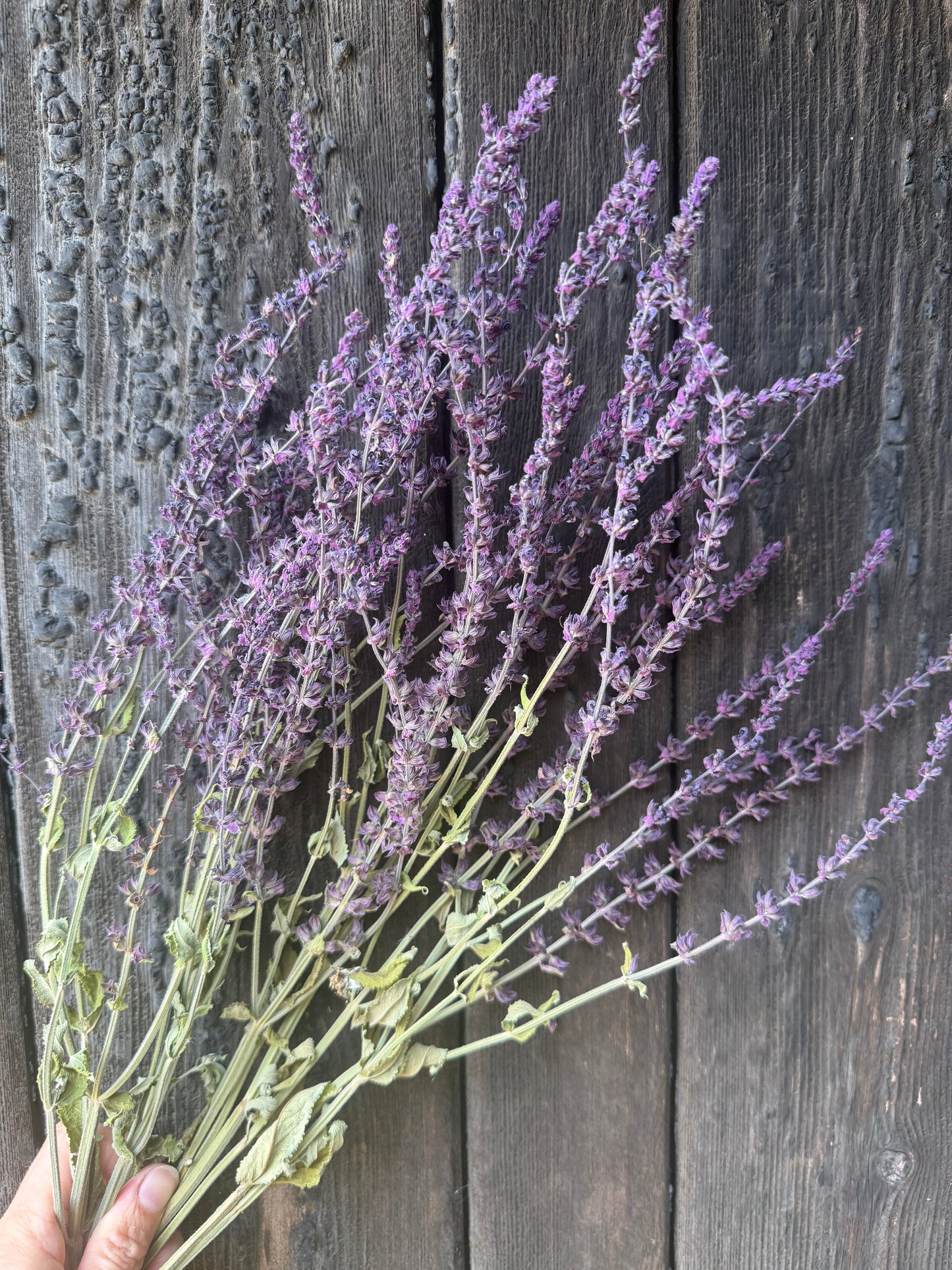
Salvia Violet Queen Dried
Couldn't load pickup availability
The dried spikes of Salvia nemorosa 'Violet Queen' show what happens after the summer flowering is almost finished. Once the small violet-purple flowers have begun to drop, dark blackish-purple calyces (the little cup-shaped structures that held each flower) remain on the spike, holding their intense colour indefinitely. Dried, they form dense structural spikes of rich burgundy-purple — the shadow rather than the bloom, moody rather than bright, quietly dramatic in exactly the way most dried flowers can't be. One of the classic hardy border perennials of the English garden, brought indoors as one of the most colour-retentive dried spikes you can grow.
Barn-dried at Salle Moor Hall, Norfolk. Bunches with stems approximately 50cm long, each topped with the distinctive dark purple calyx spike.
Hand-harvested when the calyces have set firmly on the stems but there are still some petals attached allowing them to hold their rich colour. Grown chemical-free on our own cutting field. No air miles, no imported stems, no dyes or preservatives — just gorgeous English cottage garden Violet Queen, cultivated and cared for entirely by us. Currently in stock — while our summer stock lasts.
The perennial border classic in dried form
Salvia nemorosa 'Violet Queen' is one of the most reliable hardy herbaceous perennials for UK gardens — sitting alongside the better-known 'Caradonna', 'May Night', and 'Amethyst' as one of the darker-toned varieties in the ornamental salvia range. In the garden, it's valued for its early-to-mid summer flowering, drought tolerance, deer resistance, and the way it works with roses, hollyhocks, campanula, and other cottage garden perennials. What makes it particularly good for drying is that once the flowering finishes, the calyces don't drop — they harden and hold their dark colour on the spike, becoming a structural element that can be harvested for indoor use.
What makes Violet Queen distinctive
- Dark blackish-purple calyx colour — not bright violet but moody rich purple with almost-black depth. Reads as considered shadow rather than statement bloom. Genuinely unusual in the dried flower range — most purple products aim for vivid; Violet Queen aims for depth
- Exceptional colour retention — the calyx structure is naturally woody and holds pigment indefinitely. Where flower petals fade within months, Violet Queen calyces hold their character for years
- Dense structural spike — upright rigid 50cm stems with the dark calyces packed along the upper third of each spike. Compact, contained, architecturally clean
- Papery calyx texture — naturally firm and slightly waxy to the touch. Handles well without shedding or crumbling
- Hardy perennial heritage — not a cottage garden annual harvested from one year's growing, but a classic border perennial that returns yearly. Cut from mature plants that have been building character for seasons
- Distinct from our other Salvias — different from our annual Clary Sage (Salvia sclarea), which has taller mixed-colour spikes and silver-fuzzy stems. Same genus, entirely different form and use
Styling ideas
- The dark-purple accent in mixed bouquets — where soft purple dried flowers (Lavender, Statice) provide gentle lavender tones, Violet Queen provides the dark burgundy-purple depth that mixed arrangements often lack. Anchors the arrangement without dominating
- Modern minimalist single-species — five or seven stems in a plain glass cylinder or matte vessel creates a contemporary arrangement with unusual moody character. The dark saturated colour reads as gallery-worthy rather than casual
- Autumn and winter styling — the dark purple palette suits autumn arrangements alongside warm-toned dried grasses, seed heads, and dried leaves. Also works for Christmas mantel displays combined with evergreen foliage and metallic accents
- Gothic and dark academia aesthetics — where most dried flowers aim for bright cottage cheerfulness, Violet Queen suits darker, moodier interior schemes. Reads as considered rather than gloomy
- Wedding centrepieces (moody palette) — the deep colour suits autumn weddings, gothic weddings, and any styling that wants richness rather than pastel softness. Particularly good alongside deep burgundy and cream palettes
- Small vase and bud vase displays — the 50cm stem length suits smaller vessels. Individual stems in bud vases provide continuous dark-purple accent without overwhelming the space
- Purple palette single-scheme — combine with Purple Larkspur (bright violet-blue) and Lavender (soft purple) for a rich monochromatic scheme that shows the full purple range from bright to deep to soft
Perfect dried companions
- Dried Larkspur (Purple variant) — the light-and-dark purple partnership. Bright violet-blue Larkspur spikes against dark burgundy-purple Violet Queen shows purple in two very different registers within a coherent palette
- Dried Lavender — the pale-and-dark purple pairing. Soft lavender-blue against Violet Queen's deep burgundy creates gentle purple gradation. Add fragrance to the visual purple
- Dried Echinacea Cones — the moody autumn partnership. Bronze prickly cones alongside dark-purple Violet Queen creates a rich autumn palette that reads as considered rather than clashing
- Dried Achillea 'Ballerina' or Feverfew — the cream partnership. Soft white puffballs alongside dark violet provides essential contrast in mixed bouquets and prevents the palette from reading as heavy
- Dried grasses (Bunny Tails, Foxtail Barley) — the soft neutral contrast. Cream and blush grasses against dark purple creates textural and colour variation
- Dried Statice Suworowii — the pink-and-dark-purple cottage combination. Rose-pink Suworowii spikes against dark violet Violet Queen bracts is a properly gentle cottage garden partnership
Care note. Violet Queen is among the more durable dried flowers — the calyx structure is naturally woody and papery, handling well without shedding. Keep out of direct sunlight to preserve the dark burgundy-purple colour (as with all purple pigments, prolonged sunlight will pale the tone toward brown). Handle from the base of the stems. Store dry, away from steam and damp. Given proper care, expect years of use indoors with the rich dark colour holding indefinitely.
Growing your own. Salvia nemorosa 'Violet Queen' is one of the most reliable hardy border perennials for UK gardens — plant in spring or early autumn in full sun and well-drained soil, and it returns year after year with minimal care. Drought-tolerant once established, deer-resistant, and one of the best plants for bee and butterfly forage in early to mid-summer. Divide established clumps every 3-4 years to keep them vigorous. For drying, cut spikes after flowering finishes when the calyces have set firmly. Companions include roses, campanula, hollyhocks, verbena bonariensis, and other classic cottage border perennials.